Continuing the discussion from How to use a common hardware trigger with multiple cameras:
General Information
- Product: C57-6-M
- Serial Number: 244888, 245218
- Ensenso SDK Version: 4.0.1502
- Operating System: Windows 10 64bit
- Data Attachments
-
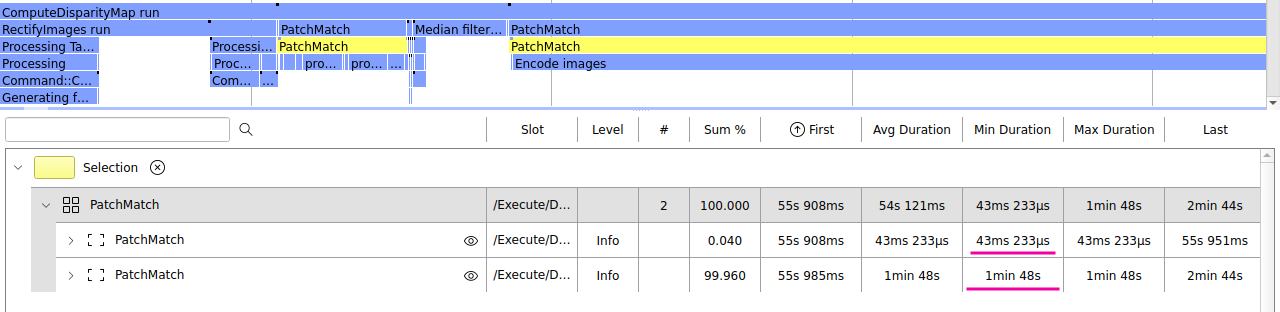
Profiler log
tmp_NxTreeEdit20260427-12.zip (16.4 MB)
-
Problem / Question
As in the code below, we open two C57 cameras, specify hardware triggers for each, execute the Trigger and Retrieve commands, and then execute the ComputeDisparityMap command.
	nxLibSetString(&error, "/Execute/Parameters/Cameras", m_serial);
	nxLibSetString(&error, "/Execute/Command", "Open");
	nxLibSetString(&error, "/Execute/Parameters/Cameras", m_serial2);
	nxLibSetString(&error, "/Execute/Command", "Open");
	nxLibSetString(&error, "/Execute/Parameters/Cameras", m_serial_C);
	nxLibSetString(&error, "/Execute/Command", "Open");
	nxLibWaitForType(&error, "/Execute/Command", NxLibItemTypeNull, 1);
	nxLibSetString(&error, "/Execute/Parameters/Cameras", m_serial_C2);
	nxLibSetString(&error, "/Execute/Command", "Open");
	nxLibWaitForType(&error, "/Execute/Command", NxLibItemTypeNull, 1);

	NxLibCommand trigger(cmdTrigger);
	trigger.parameters()[itmSubset] = valAll;
	trigger.execute();

	NxLibCommand retrieve(cmdRetrieve);
	retrieve.parameters()[itmTimeout] = -1;
	retrieve.parameters()[itmCameras][0] = m_serial;
	retrieve.parameters()[itmCameras][1] = m_serial2;
	retrieve.execute(static_cast<bool>(false));

	while (1) {
		std::this_thread::sleep_for(std::chrono::microseconds(10));
		if (retrieve.finished()) {
			retrieve.assertSuccessful();
			assert(retrieve.result()[m_serial][itmRetrieved].asBool());
			assert(retrieve.result()[m_serial2][itmRetrieved].asBool());
			bool rc2 = retrieve.result()[m_serial2][itmRetrieved].asBool();
			if (rc2) {
				break;
			}
		}
		if(cancel){
			retrieve.cancel();
			while (true) {
				if (retrieve.finished()) {
					return(1);
				}
			}
		}
	}
	retrieve.parameters()[itmTimeout] = 1000;
	retrieve.parameters()[itmCameras][0] = m_serial_C;
	retrieve.parameters()[itmCameras][1] = m_serial_C2;
	retrieve.execute();

	nxLibSetString(&error, "/Execute/Command", "ComputeDisparityMap");
	nxLibWaitForType(&error, "/Execute/Command", NxLibItemTypeNull, 1);

	nxLibSetString(&error, "/Execute/Command", "ComputePointMap");
	nxLibWaitForType(&error, "/Execute/Command", NxLibItemTypeNull, 1);
	//・・・
However, it takes more than a minute for the ComputeDisparityMap command to complete.
(We are waiting for a response with
nxLibWaitForType(&error, “/Execute/Command”, NxLibItemTypeNull, 1);)
Is there something wrong with how we are using it?
I am attaching the profile obtained at that time.
The single-camera version of the above code works normally.
Thank you in advance.
Best regards,
K.N,